Your organisation wants answers. I find them by combining analytics, behaviour and learning.
Behavioural scientist · Analytics professional · Learning designer
Photo: Tracey Harrison-Hill
◉
Behavioural Insight
Comprehending the psychology behind decisions, learning and habit — and what it means when you're designing for real people, not average ones.
◇
Data & Analytics
Growing technical capability in Python, R and Power BI — applied to real problems in education, behaviour and strategy.
◈
Learning Design
Designing curricula that are evidence-based, inclusive, and built around how people actually learn — across diverse adult cohorts and delivery modes.
About
I study behaviour. All of it.
Two legs, four, feathered, or neural.
My driving force has always been understanding behaviour. In animals, that drive was enough to represent Australia at the World Agility Championships; in people, enough to spend a career asking how they engage, how they learn, how they make meaning from experience. That drive has run through a PhD in consumer behaviour, academic program leadership, curriculum design for diverse adult cohorts, and now formal training in business analytics and AI, not as a departure from that foundation, but as its evolution.
Working with Python, R, Power BI and data visualisation, I bring a layer of analytical visibility to the behavioural and learning design questions I have always asked.
I am now focused on the intersection of learning design, analytics, and AI adoption, combining behavioural insight with data capability for organisations navigating complex change. I am based in south-east Queensland and work best in roles where evidence, design and implementation sit together.
That same curiosity about behaviour follows me outdoors. As a landscape and wildlife photographer, I spend focused time reading movement and anticipating the moment — the same research, planning and patience I bring to my work. The bird on this page is one of my captures; you can see more at photobytrace.com.
How I Work
How I think, and why it matters
01
I start with the question, not the tool
Before I open a dataset or pick a method, I want to understand what is actually being asked. Not the presenting question, but the real one underneath it. In my experience, the most useful analytical work starts with a conversation about what a decision-maker genuinely needs to know, and works backwards from there.
That instinct comes from a long career in curriculum design, where the same principle applies: you don't start with content, you start with what you want people to be able to do. The framing shapes everything that follows.
02
I work across the whole chain
I am comfortable across the full research-to-insight chain: designing and developing questionnaires, collecting and inputting data, and drawing on public datasets alongside data I've gathered myself. From there, I clean and transform it in Python, build models in R, visualise findings in Power BI or R, and explain what it means in plain language to people who don't care about the method.
That last part matters as much as the first. Analysis that lives in a report nobody reads hasn't done its job.
03
I bring a behavioural lens
My PhD was in consumer behaviour, specifically, how tourists make decisions about destinations. I've spent a long time thinking about what actually drives human choices, and how hard it is to predict behaviour from surface-level data alone. That makes me cautious about over-interpreting results and curious about what the data might be missing.
It also makes me interested in implementation: not just what the data says, but what needs to change in an organisation for evidence to actually influence decisions.
04
I work best in complex, multi-stakeholder environments
Most of my career has involved translating between different groups of people: academic staff and students; executives and operational teams; even trainers and dog owners. In learning design specifically, I've been both the subject matter expert and the person building the learning solution, which means I know exactly where those two roles tend to talk past each other. I am used to working in environments where the 'right answer' is contested, the data is incomplete, and the most important skill is knowing how to listen and communicate without undermining confidence.
05
Outside of work
I am a landscape and wildlife photographer — long exposures, wide angles, early mornings, dark skies. I find that photography teaches the same thing that good analysis does: research, planning, patience, precision, and a willingness to look at something ordinary until you see it differently.
I am also a qualified dog agility judge, instructor and long-standing competitor in the sport, roles I have held for over two decades. I mention this not as a quirky aside, but because it reflects something I value: sustained commitment to a community and giving back.
Capability Evidence
My Work in Practice
The following projects were completed as part of my Master of Business Analytics at the University of Queensland. They are presented as evidence of analytical capability, not as consulting engagements or paying client work. Each project involved a brief or dataset created for academic purposes, with the exception of the Queensland educational equity analysis and the real estate predictive modelling project, both of which used real, publicly available data.
▶ Video
● Real public data
Queensland Education Equity Decision Support Dashboard
NAPLAN · ICSEA · IRSD · 2025
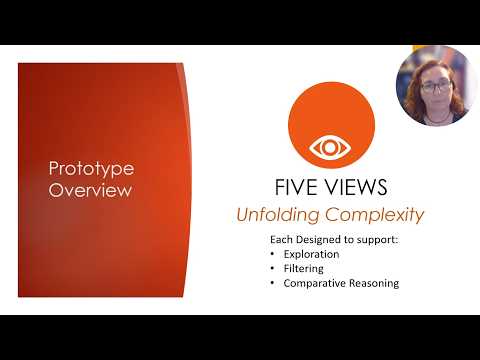
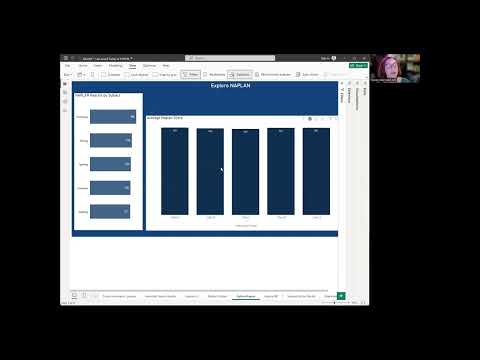
Integrated and analysed education, demographic and geospatial data from multiple public sources (ACARA, ABS, DSS, ADII) to develop an interactive decision-support dashboard for exploring educational equity across Queensland. Applied Visual Design and UX theory to enable stakeholders to easily navigate, identify regional patterns, compare educational indicators and drill down to school-level insights through dynamic filtering.
Applying an Ethical, Legal and Societal Impact framework to a live regulatory problem: how Australian higher education should respond to generative AI in assessment.
A stakeholder-commissioned case brief requiring a data solution for an educational context. End-to-end from analysis brief to working prototype.
PythonPower BIMiroJupyter
● Real dataset (provided)
Jupyter NB
Real Estate Predictive Modelling
Logistic Regression · Elastic-Net · Random Forest · 2025
Comparing three modelling approaches — including natural language features from listing text — to predict sale outcomes, then interpreting the winning model properly rather than treating it as a black box.
Analysis of competitor review data and single-venue customer patterns. Regression modelling, time-series forecasting, and dual-audience communication.
RRegressionTime-seriesggplot2
◇ Simulated consulting brief
Digital Transformation Strategy
Gold Coast Hinterland Museum · 2025
A strategic transformation plan for a values-driven tourism business. Environmental analysis, Digital First Framework, values-aligned roadmap.
StrategyYoo & BerenteCRMCanvaRoadmap
◇ Simulated consulting brief
National Sustainability Framework: Project Implementation Plan
Fictitious national hospitality & events group · 2025
A full business case for implementing national sustainability standards across a hotel and events organisation — financial modelling, governance, risk and change strategy in one plan.
Designed and implemented a star-schema data warehouse for a bicycle company's sales system, built an ETL pipeline in SSIS, and queried the dimensional model in SQL to generate business insights.
SQLSSISStar SchemaETLDimensional Modelling
◈ Self-directed AI build
Jupyter NB
Scope-to-Ship: Automating a Data-Cleaning Workflow with AI
Self-designed automation framework · 2026
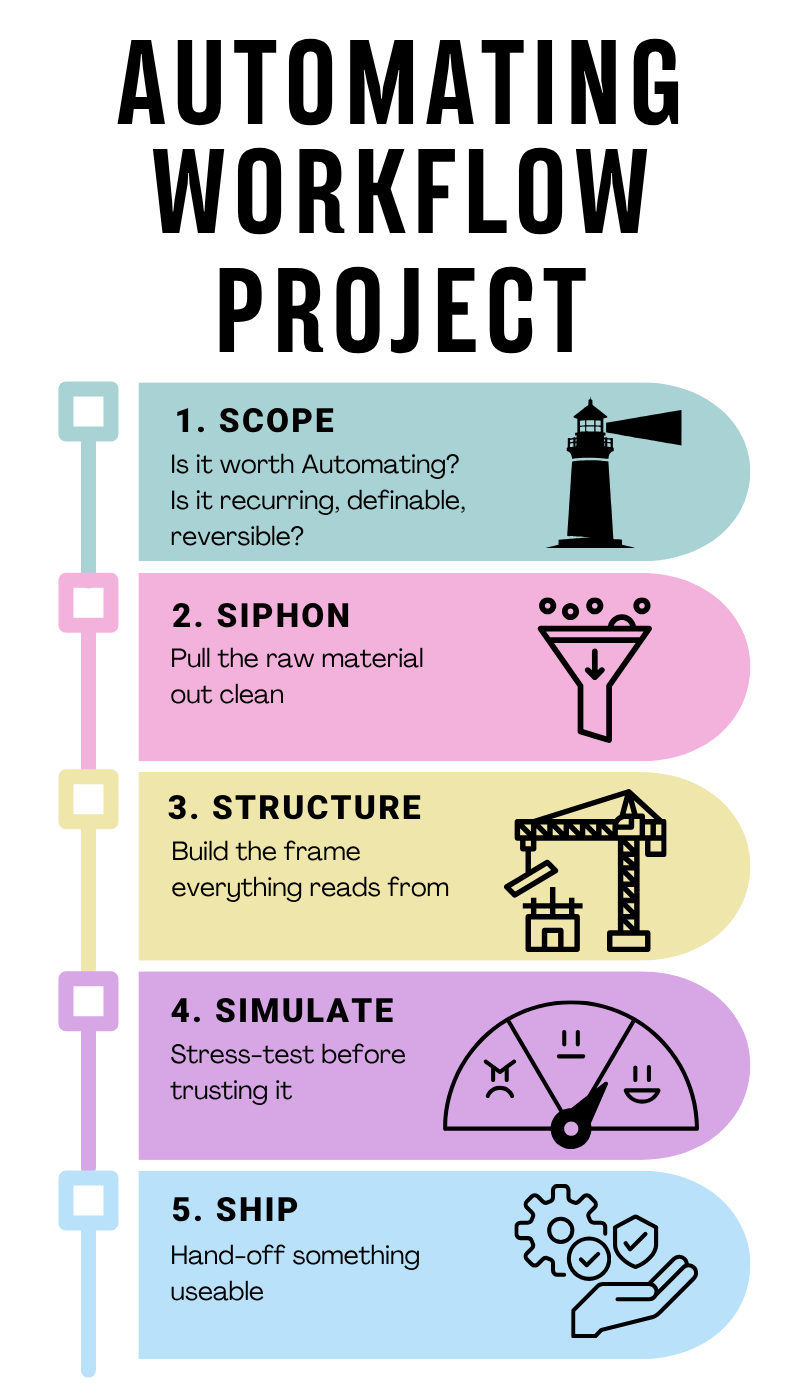
Turned a recurring data-cleaning task into a working Python tool, built with Claude using a five-stage framework: Scope, Siphon, Structure, Simulate, Ship. This automation is designed to keep the process honest instead of just fast, and tool-agnostic so that the system is transferable.
PythonJupyterpandasopenpyxlClaudeWorkflow Design
Learning Design
Designing for How People Learn
This work spans a genuine range: over a decade of subjects I designed and delivered as a university lecturer, formally trained through a Graduate Certificate in Higher Education in 2001, plus a current learning design proposal from a postgraduate microcredential at UTS. The microcredential was a mindful refresh, updating with contemporary frameworks and the realities of designing for AI. I've labelled each clearly — delivered subject or academic proposal — because that distinction matters, and I'd rather you know exactly what you're looking at.
I lost most of the original teaching artefacts from these subjects when I stepped away from work unexpectedly for cancer treatment in 2017. At the time, I was not anticipating needing them again. What's shown here is drawn from the subject guides and outlines that survived, plus my own account of the design thinking behind them.
○ Academic proposal
AI-Supported Marketing Content Generation
Designing for Learning · UTS · 2026
A structured learning intervention to build a marketing team's capability in prompting, evaluative judgement and iterative refinement of AI-generated content — grounded in Merrill's First Principles and Jonassen's ill-structured problem theory.
Merrill's First PrinciplesJonassenUnderstanding by DesignNeeds Analysis
◈ Self-directed AI build · 2026
Audio Brief
Scope-to-Ship: From Lecture Deck to Audio-Ready Summary
AI-assisted learning design pipeline · 2026
Applied my five-stage framework — Scope, Siphon, Structure, Simulate, Ship — to a recurring learning design task: turning a dense 26-slide workshop deck into a short audio summary and a check-your-understanding quiz, with the tool set up to flag what it couldn't extract.
Tourism & Leisure Management: Designing for Blended-Media Assessment
JCU, multi-campus & online · 2017
Replacing a written assignment with a self-produced narrated video blog — years before video-based assessment was common — while keeping every outcome cleanly mapped to a specific, assessable task.
Club & Gaming Management: Learning Through the Mechanism Itself
JCU, Townsville · Intensive face-to-face · 2011
An assessment design where the participation-reward mechanic doubles as the content: shaping active discussion while giving students a lived experience of the reinforcement principles the subject asks them to critique.
Queensland has deep and persistent patterns of educational disadvantage — concentrated in regional and remote areas, in schools with high Indigenous enrolment, and in communities with low socio-economic status. These patterns are documented in national data, but they can be hard to act on because the data is fragmented, the geography is vast, and the relationships between different indicators are not always obvious.
The project brief asked me to explore these relationships and produce a tool that could help a decision-maker — in this case, a hypothetical educational organisation considering a pilot study — understand where disadvantage is most concentrated and how to select target sites systematically.
What I did
Data Engineering: Integrated ABS, ACARA, ADII and DSS datasets into a unified analytical dataset.
Statistical Analysis: Developed composite indicators and comparative measures of educational need.
Interactive Dashboard: Built a multi-tab R Shiny application for exploratory analysis and decision support.
Geospatial Analytics: Implemented interactive Leaflet maps using GeoJSON layers to visualise LGAs and schools with spatial filtering, drill-down capability and a school cluster selection tool.
Visual Design Theory: Applied data visualisation theory to create efficient and appropriate visualisations that communicate key insights to stakeholders.
UX Design: Designed the tool so a non-technical user could filter and explore findings without needing to interpret the underlying analysis
▶ Watch the walkthrough
▷ Opens on YouTube in a new tab
What it showed
The analysis confirmed that Indigenous students are disproportionately represented in the 'Needs Additional Support' proficiency category across all NAPLAN subjects and year levels — across both reading and numeracy, and across Year 5 and Year 7 cohorts.
The school cluster selection tool showed that regions differ meaningfully in more than geography alone — in their ICSEA profiles, Indigenous enrolment concentration, remoteness classifications and access to hub airports. These differences matter for how any intervention would need to be designed and resourced, and are exactly the kind of pattern a static report would struggle to surface as clearly as an interactive, filterable tool.
What this project demonstrates
This project sits at the intersection of technical analysis and social purpose — which is where I do my best work. It required me to handle real data quality issues, make design decisions about how to present complex relationships to a non-specialist audience, and produce an interactive output that could actually be used to inform a decision.
It also reflects something I care about: that data work in education should be in service of equity, not just efficiency. The patterns in this dataset are not abstract — they represent real children in real schools. I tried to design the tool in a way that kept that visible.
○ Academic brief · MBAn · UQ · 2024
Educational Data Dashboard Prototype
A stakeholder-commissioned case brief: from analysis brief to working Power BI prototype.
Context
Master of Business Analytics · UQ, 2024
Data
Case-based dataset · Queensland school & postcode data
Tools
Python · Jupyter · Power BI · Miro
Output
Working dashboard prototype · Stakeholder demo
Note: The problem context was drawn from a real stakeholder brief; datasets used reflect Queensland school and postcode data.
The problem
The brief was structured as a stakeholder-commissioned data solution problem: an educational department with a dataset and a set of questions they needed answered. The challenge wasn't just technical — it was about understanding what the stakeholders actually needed to know, and designing a solution that would be useful to them rather than merely correct.
I approached it the way I'd approach any design problem: start with the people, not the data.
What I did
Conducted a structured stakeholder analysis — identifying decision-makers, their information needs, and the pain points a data solution would need to address
Used Miro to wireframe the dashboard before writing a single line of code — mapping the logical flow of information and the visual hierarchy a non-technical user would need
Cleaned and transformed the provided datasets using Python in Jupyter Notebook, handling missing values, reformatting variables and building the derived metrics the dashboard required
Built a Power BI dashboard prototype visualising student outcome patterns in a format aligned to the identified stakeholder goals
Presented the solution as a stakeholder demonstration — explaining not just what the dashboard showed, but why the design decisions were made
▶ Watch the walkthrough
▷ Opens on YouTube in a new tab
What this project demonstrates
This project shows me working as a solution designer, not just a data analyst. The wireframing step — doing the thinking before touching the tools — is something I brought from a career in learning design, where the same principle applies: you don't build the content until you've designed the learning experience.
The ability to move from stakeholder analysis to data transformation to visual communication, and then present the output to a non-technical audience, is the full capability chain this kind of role requires.
○ Simulated brief · MBAn · UQ · 2024
Restaurant Review & Customer Behaviour Analysis
Identifying performance drivers from competitor and single-venue data — for two very different audiences.
Context
Master of Business Analytics · UQ, 2024
Data
Simulated competitor & single-venue datasets
Tools
R · ggplot2 · Regression · Time-series
Output
Technical report · Stakeholder video pitch
The problem
The brief gave me two datasets related to a restaurant business: one capturing review and rating data across competitors, another detailing customer patterns for a single venue. The task was to identify what was driving performance differences — and then communicate those findings twice: once to a technical supervisor, once to a non-specialist business audience.
That dual-audience requirement was, for me, the most interesting part of the brief.
What I did
Performed exploratory data analysis across both datasets, using ggplot2 visualisations to surface patterns before applying any modelling
Built regression models to identify key drivers of customer ratings and review volume — including menu type, pricing, proximity to competitors and day-of-week effects
Conducted time-series analysis to identify seasonal patterns and forecast forward demand under different operating assumptions
Produced a structured technical report written for a hypothetical supervisor — explaining methods, assumptions, limitations and findings with statistical precision
Recorded a separate persuasive video pitch for a business audience — translating the same findings into operational recommendations without statistical jargon
▤ View the R Notebook
▶ Watch the stakeholder video pitch
▷ Opens on YouTube in a new tab
What this project demonstrates
This project reflects something I think is undervalued in analytics: the discipline of saying the same thing two different ways to two different audiences, without losing accuracy in the technical version or accessibility in the business version.
My background in learning design is directly relevant here. I have spent a significant portion of my career translating complex ideas into forms that different learners can use. Data communication is the same skill applied to a different context — and the regression results are only useful if someone acts on them.
◇ Simulated consulting brief · MBAn · UQ · 2025
Digital Transformation Strategy
Gold Coast Hinterland Museum — values-aligned transformation for a community tourism attraction.
Context
Master of Business Analytics · UQ, 2025
Approach
Environmental scan · Yoo & Berente · CRM
Tools
Canva · Video presentation
Output
Formal strategy report · Stakeholder video pitch
The problem
This venue is a small, community-focused tourism attraction with high visitor satisfaction, deep local connection, and almost no digital infrastructure. The brief asked me to design a digital transformation strategy — without overwhelming a small team or undermining the authentic character of the business.
The constraint that made this interesting was the values alignment problem. A transformation strategy that ignored the organisation's sense of place and purpose would fail, even if it was technically sound.
What I did
Conducted an environmental scan drawing on visitor satisfaction data, competitive context and the operational profile, including a customer journey mapping exercise identifying pain points across two distinct visitor personas
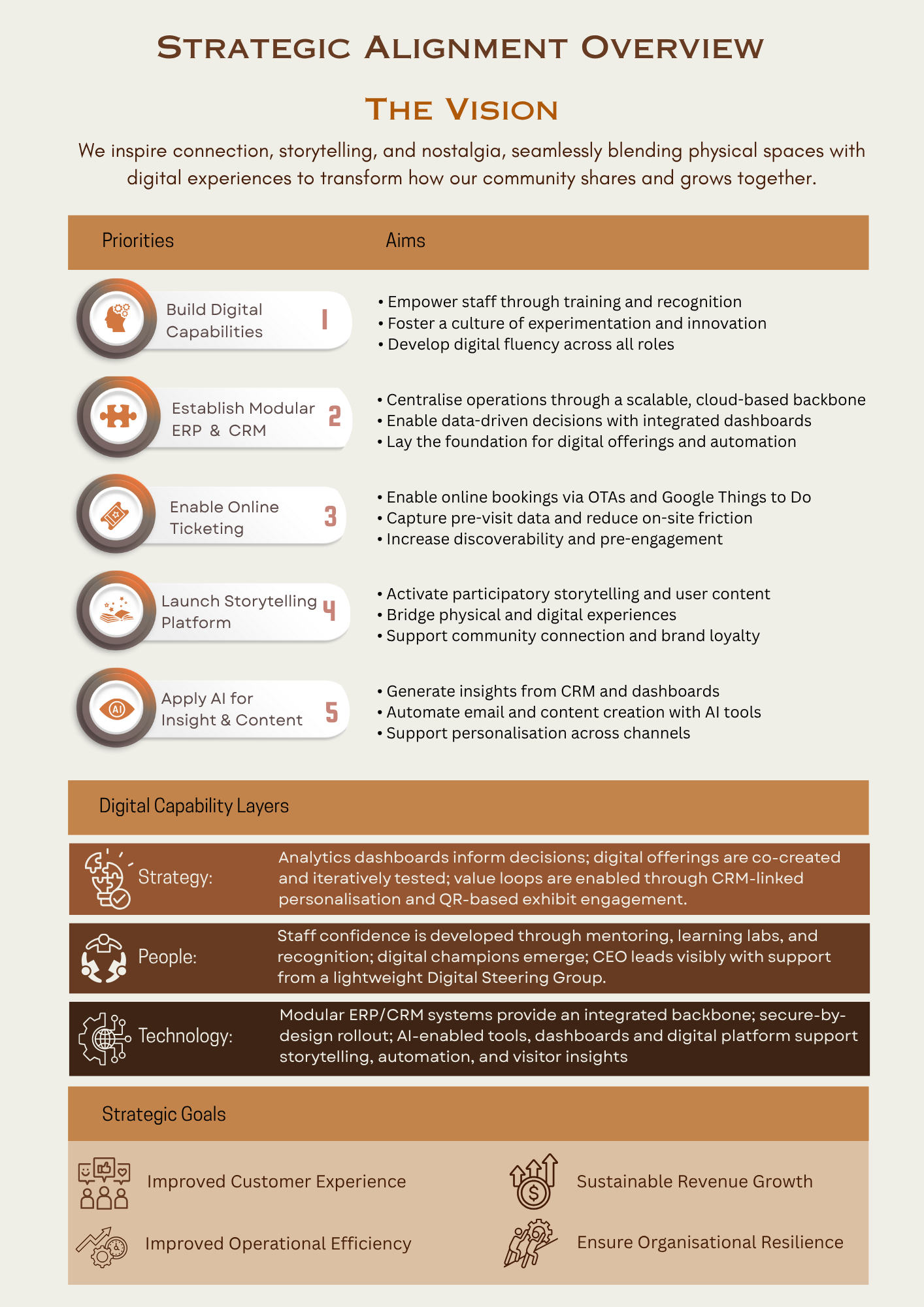
Applied the Yoo & Berente Digital First Framework to structure five transformation priorities: building digital capability, implementing modular CRM, enabling online ticketing, launching a digital storytelling platform and applying AI for insight and content
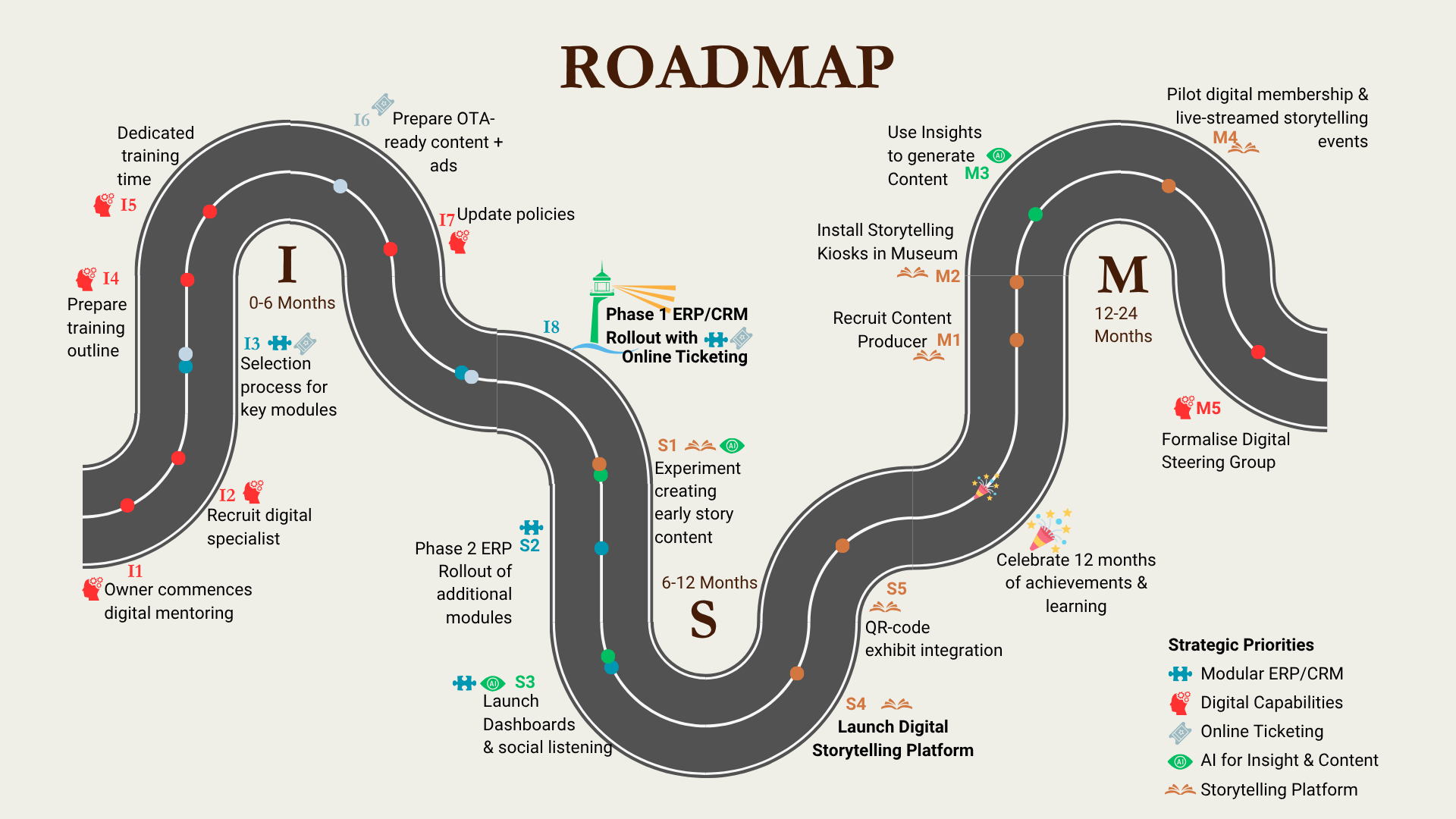
Designed a two-year implementation roadmap with phased actions, anticipated outcomes and risk analysis for each priority
Framed the entire strategy around deepening community connection rather than replacing tradition — using the language of storytelling rather than disruption
Delivered findings as a formal report and a persuasive video presentation designed for a small business owner, not a corporate board
Two-year implementation roadmap, phased across capability, systems and storytelling priorities
What this project demonstrates
This project shows me as a strategic thinker who can hold technical and human considerations in the same frame. The most important finding was not about technology — it was about sequencing. Digital transformation in a small, values-driven organisation cannot be led by systems. It has to be led by capability-building and cultural confidence.
This is the same insight that applies in education: you can design the best learning experience in the world, but if the conditions for implementation aren't right, it won't work.
Strategic alignment overview — vision, priorities and goals mapped to a single framework
▲ Policy & ethics analysis · MBAn · UQ · 2026
Assessment Integrity in the Age of Generative AI
Applying the ELSI framework to analyse how Australian higher education should respond to generative AI, from the regulatory perspective of TEQSA.
Context
Master of Business Analytics · UQ, 2026
Approach
ELSI framework · TEQSA regulatory lens
Format
Group presentation · Individual policy report
Output
Policy-level recommendations
The problem
Generative AI has moved faster than the policy frameworks meant to govern it, and nowhere is that gap more visible than assessment integrity in higher education. The brief asked our group to apply the ELSI framework — Ethical, Legal and Societal Impact — to analyse how Australian universities, and the regulator TEQSA, should respond.
This wasn't a hypothetical exercise for me. I was working as a teaching fellow, marking assessments, while generative AI tools were already reshaping what students were submitting. At the same time I was also a postgrad student being encouraged to learn, experiment and apply AI within my work. The question of where the line sits between legitimate AI-assisted learning and academic misconduct wasn't abstract — it was the new norm. It was Tuesday.
What I did
Worked in a group to apply the ELSI framework systematically across three dimensions: ethical (what's fair to students and staff), legal (what TEQSA's regulatory position requires), and societal (what happens to the credibility of a qualification if integrity can't be assured)
Co-presented the group's findings to the cohort, then independently authored a full report translating the analysis into policy-level recommendations
Reviewed TEQSA's current guidance and academic integrity literature to ground the analysis in the actual regulatory environment rather than speculation
Considered the perspective of every stakeholder in the system — students, academic staff, institutions and the regulator — rather than treating this as a single-sided "catch the cheats" problem
Narrowed my individual reflection to a sharper thread within the group's broader work: the risk that habitual GenAI use erodes students' epistemic autonomy — their capacity to reason, judge and trust their own thinking — even in cases where academic integrity itself isn't formally breached
Drew on emerging research linking AI use to "cognitive surrender" and reduced critical thinking to argue this is a developmental harm, not just an integrity issue — and one that already falls within TEQSA's existing mandate to safeguard student interests
▤ View the group presentation deck
▶ Watch my presentation excerpt
▷ Opens on YouTube in a new tab
What it showed
The clearest finding was that policy responses focused purely on detection — AI-detection software, harsher penalties — are already behind the problem, and likely to stay behind it. The more durable answers involve redesigning assessment itself: building tasks where AI-assisted work is either transparent and permitted, or structurally harder to produce without demonstrating genuine understanding.
My individual analysis pushed this further. While students submitting work they didn't do is problematic, there is a deeper risk when using AI: performance on immediate tasks can look fine; meanwhile, the underlying capacity to reason independently is gradually declining. Emerging research calls this cognitive surrender. That reframes the problem from something you police to something you have to catch early. It's why my recommendations centred on building in checkpoints that test reasoning while a cohort can still be helped, rather than only tightening detection after the fact.
What this project demonstrates
This project sits exactly at the intersection I keep returning to: analytical rigour applied to a genuinely human problem, in an education setting I know from the inside, not just from a case study.
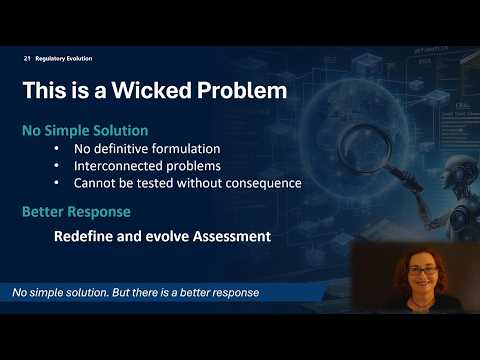
It also connects directly to work I did in my own teaching practice: as part of an AI-in-learning-design bootcamp, I built structured prompts to support how I gave feedback on student assessments. This is an application of AI I found genuinely useful in my own workload, but one that sits close to the same ethical line this project examines. I don't think that tension resolves neatly — it's part of the wicked problem the higher education sector is now facing.
◇ Simulated consulting brief · MBAn · UQ · 2025
National Sustainability Framework: Project Implementation Plan
Applying advanced analytics and financial modelling to implement the National Sustainability Framework for the Visitor Economy, for a fictitious national hotel and events organisation.
Context
Master of Business Analytics · UQ, 2025
Approach
Business case · Stage-gate governance
Tools
Financial modelling (NPV/ROI) · Risk register
Output
4-year implementation plan · Business case report
The problem
The brief placed me inside a fictitious national hotel chain and event management organisation that needed to implement the National Sustainability Framework for the Visitor Economy — a real Australian policy framework — across its operations. The initial proposal was group work that then carried through into an individually authored final report, which included a full business case.
A sustainability framework is easy to endorse in principle and hard to fund in practice. The real work was making the case for something that pays off over years, to an organisation that reports quarterly.
What I did
Built a four-year financial model estimating NPV and ROI for the sustainability implementation, translating sustainability outcomes into numbers a finance team would actually act on
Designed a phased project schedule using stage-gate governance, so leadership could commit incrementally rather than approving the whole four-year spend upfront
Developed a comprehensive risk register identifying operational, financial and reputational risks at each implementation phase, with corresponding mitigations
Built a change adoption and benefits realisation strategy addressing the human side of the plan: how staff across a multi-site hotel and events business would actually be brought along, not just informed
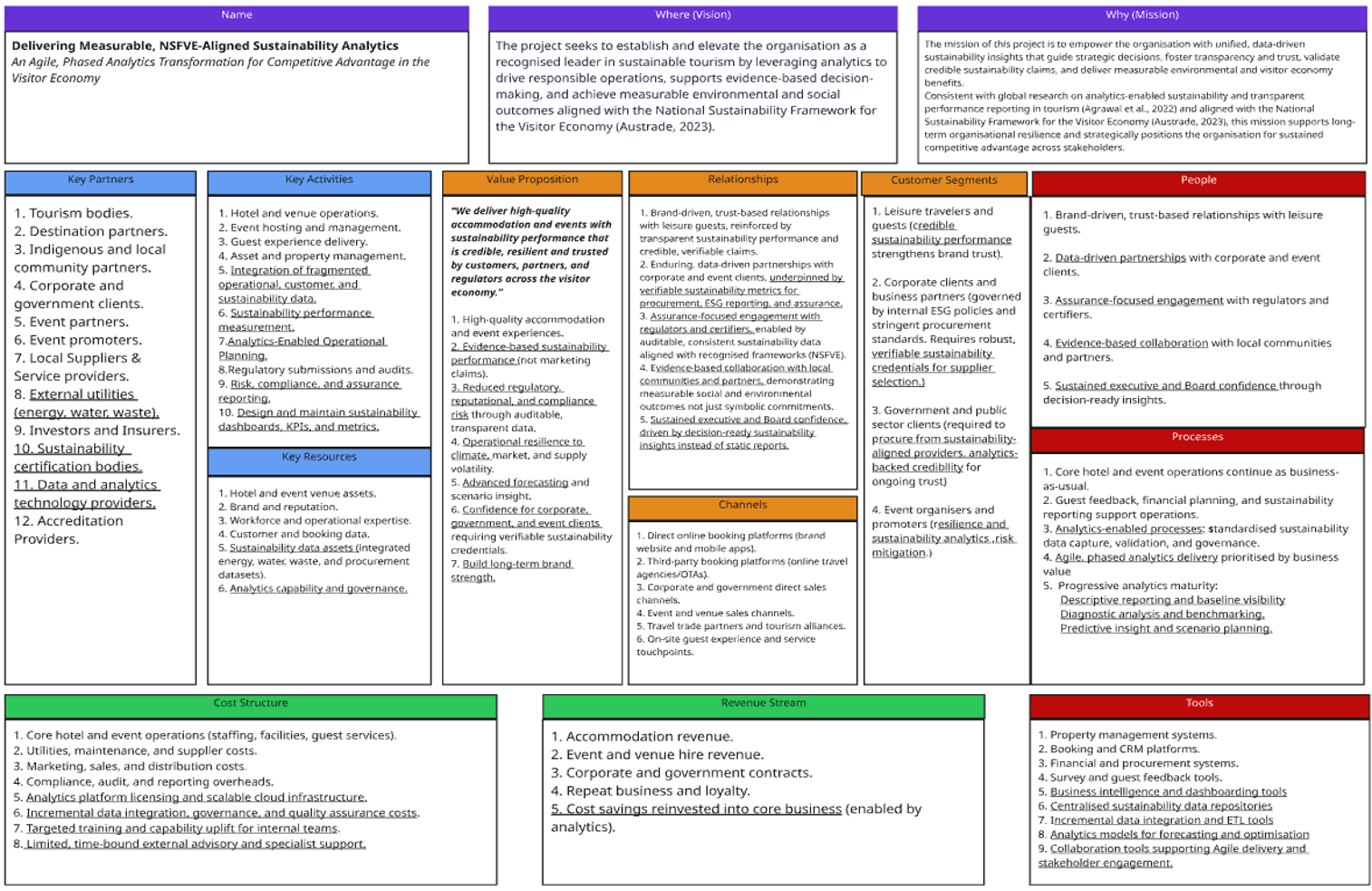
Constructed a Business Model Canvas to map how sustainability initiatives intersect with the organisation's existing value creation model — establishing the strategic grounding that the financial modelling, governance and risk workstreams were then built on
Business Model Canvas mapping value creation against the National Sustainability Framework for the Visitor Economy
What it showed
The strongest argument for the plan turned out to be risk-avoidance framing rather than pure ROI. For a hospitality and events business, the reputational and regulatory risk of falling behind sustainability expectations — particularly from corporate and government event clients — was a more persuasive lever than the financial case alone. Combining both made the strongest business case.
What this project demonstrates
This project shows I can build a genuinely complete business case — not just a model, not just a narrative, but financial modelling, governance structure, risk management and change strategy held together as one coherent plan.
It also reflects a pattern in my career: whether it was accreditation documentation at Griffith or operational systems at a small museum, I've consistently been the person who translates a good idea into something that survives contact with implementation.
● Real dataset (provided) · MBAn · UQ · 2025
Real Estate Predictive Modelling
Comparing logistic regression, Elastic-Net and random forest models — including text-derived features — to predict whether a property sells above or below its listing price.
Context
Master of Business Analytics · UQ, 2025
Data
Real property sales dataset (provided)
Tools
Python · Logistic Regression · Random Forest · SHAP
Output
Hybrid predictive model · Interpretability report
The problem
The brief provided a real property sales dataset and a clear prediction target: would a given property sell above or below its listing price? Underneath that simple question was a genuinely interesting modelling problem, because the listing text itself — the words agents chose to describe a property — turned out to carry real predictive signal alongside the structured data.
The harder constraint wasn't accuracy. It was interpretability: a model nobody can explain isn't much use to a real estate business trying to understand and act on its predictions.
What I did
Built and compared three modelling approaches: logistic regression as an interpretable baseline, Elastic-Net for regularised feature selection, and random forest for non-linear pattern capture
Engineered text-based features from property listing descriptions using both TF-IDF and SBERT sentence embeddings, and tested whether they improved prediction beyond the structured variables alone
Selected a hybrid final model that balanced predictive performance against interpretability, rather than defaulting to whichever model scored marginally highest
Used SHAP values to interpret individual predictions and calibration analysis to check that predicted probabilities could actually be trusted at face value, not just ranked correctly
▤ View the Jupyter Notebook
What it showed
Text-derived features measurably improved prediction over structured data alone — the way a property was described genuinely correlated with sale outcomes, not just with price. But the more important finding was procedural: the interpretability work using SHAP surfaced which variables were driving individual predictions, which is what would actually let a real estate business trust and use the model rather than treating it as a black box.
What this project demonstrates
This project is the clearest technical evidence in my analytics work of moving beyond "which model scores highest" to "which model can someone actually use and trust" — a distinction I think separates a data science exercise from a genuinely useful analytics product.
It's also the project that pairs most naturally with my quantitative research training from my PhD: model comparison, interpretation, and appropriate scepticism about what a number is actually telling you.
◇ Simulated company dataset · GCBusAn · UQ · 2024
VEVO Bikes Data Warehouse
Designing and implementing a star-schema data warehouse, from dimensional model to a working ETL pipeline.
Context
Graduate Certificate in Business Analytics · UQ, 2024
Data
VEVO Bikes transactional sales data (course dataset)
Tools
SQL · SQL Server Management Studio · SSIS
Output
Implemented star schema · ETL pipeline · SQL query insights
The problem
The brief asked me to design a star-schema data warehouse for a bicycle company's sales system, then query the dimensional model to generate business insights — including its most profitable product categories, how territory profitability shifted over time, and who its key customers were outside Australia.
Underneath the technical exercise was a genuinely useful discipline: a dashboard or report is only as trustworthy as the data model beneath it, and this project was about getting that foundation right.
What I did
Designed a star schema using Kimball's Four-Step Process, with grain set at the individual order-item level
Built five dimension tables — Products, Customers, Sales Team, Special Offers and Date — alongside a fact table capturing granular sales transactions
Implemented the dimensional model as an ETL pipeline in SQL Server Integration Services (SSIS), including source connections, transformations to flatten hierarchies, and load steps into each dimension and fact table
Wrote SQL queries against the dimensional model to generate business insights — profitability by product category, territory performance over time, and top customers by profit outside Australia
▤ View the dimensional model & ETL implementation
What it showed
Using profit per item — rather than revenue — as the key measure changed the picture of which product categories and territories actually performed best, since revenue alone doesn't account for cost or discounting.
The dimensional model held up under real analytical pressure: querying it to answer three quite different business questions (profitability by category, territory trends over multiple years, and customer-level profitability) without needing to restructure the underlying tables.
What this project demonstrates
This is the only project in my portfolio that evidences extract-transform-load (ETL) explicitly, and it sits underneath everything else I do with dashboards and analysis: a well-designed dimensional model is what makes an interactive tool trustworthy rather than just good-looking.
It was also a foundational exercise, not a production system — the honest scope of a course project — but the underlying discipline (grain, dimensional design, ETL logic) transfers directly to real data warehousing work.
◈ Self-directed AI build · 2026
Scope-to-Ship: Automating a Data-Cleaning Workflow with AI
Turned a recurring data-cleaning task into a working Python tool, built with Claude using a five-stage framework: Scope, Siphon, Structure, Simulate, Ship. This automation is designed to keep the process honest instead of just fast, and tool-agnostic so that the system is transferable.
Context
Self-directed project · 2026
Task
Field matching & format-mismatch detection across public datasets
Tools
Python · Jupyter · pandas · openpyxl · Claude
Output
Working Python notebook · Reusable five-stage framework
The problem
Every public dataset I pull down starts the same way: opening it, scanning columns, and playing a guessing game about whether "cust_id" in one file means the same thing as "client_number" in another. Or, whether the date fields are formatted consistently, or about to break a downstream join. This procedure came up often enough to stop being a one-off annoyance and start looking like a candidate for automation.
My automation education began with a bootcamp on AI in Learning Design by Dr Philippa Hardman, but it immediately made me curious about the potential for using it within data analytics processes too. After some research, I had a process mapped out.
The first filter I apply before deciding whether it is an automation candidate in AI: is this a recurring process that I do often, am I able to walk through and define each step, is it low on judgment until the very end, and do I already know exactly what "done well" looks like? This task cleared all three, so it earned a spot on the build list.
What I did
Sized-up the task: how often does it come up, how much of it is mechanical versus judgment-based, and what actually breaks if it's done badly?
Designed a five-stage framework — Scope, Siphon, Structure, Simulate, Ship. Five checkpoints that keep an automation honest and transferable instead of just fast.
Built a Python notebook that runs two matching signals side by side: how similar the field names are (after normalising case and punctuation) and how much the underlying values overlap (Jaccard similarity on unique values). Name similarity alone is often wrong; value overlap is where the real evidence can be seen.
Blended both into a single confidence score, with a threshold below which matches don't make the report. Also a date-aware overlap check that parses date-shaped columns before comparing them, so 2024-01-25, 25/01/2024 and 01-25-2024 still register as the same date once format has been determined.
Built the system tool-agnostic. Claude is my current AI of choice, but the durable layer isn't the AI harness; it is the context files, skills, markdown documents, workflows, reference docs, decision logs, connection maps and business rules. Store those cleanly, and they migrate into any future AI. The tool is the interface. The automation system is the structure.
The five stages: Scope, Siphon, Structure, Simulate, Ship
▤ View the Jupyter Notebook
What it showed
Two things stood out. First, the Simulate stage catches what demonstrations tend to hide. I built two small synthetic datasets deliberately designed to resemble the kind of mismatch I hit constantly. It used the same twenty customers, one dataset calling them "customers" and the other "clients", one field renamed, one date field reformatted. The matching logic found three of the four real matches immediately. The fourth, the reformatted date field, it missed completely. This was because two differently-formatted date strings share zero characters in common when compared as strings. That's precisely the kind of mismatch the tool exists to catch, and the first version would have missed the most common real-world example of it. The fix was five lines: detect date-shaped columns first and compare them as dates, not strings. It only became obvious because I tested with something messy instead of something clean.
Second, confidence-scored review beats silent fixing; I learned this on the Bootcamp. The output is a two-tab spreadsheet: one tab listing every candidate field match with a confidence score and a formatting-mismatch flag, the other summarising each source dataset. This isn't a tool that silently fixes data; it's a tool that shows you where the disagreements are, so a five-minute review replaces an hour of manual column-hunting. The judgment about whether a match is actually the same field still belongs to me. The tool's job is to make that judgment fast instead of tedious.
What this project demonstrates
This is analytical judgment applied to AI use, not just tool fluency. The framework — Scope, Siphon, Structure, Simulate, Ship — isn't specific to datasets; it transferred cleanly to an entirely different problem a few weeks later (turning a lecture deck into an audio-ready summary and quiz). Same shape, same checkpoints, different content.
It also reflects a deliberate stance on how to work with AI. Tools change. The system needs to survive that. The durable layer is the structure: the context files, skills, workflows, decision logs and business rules that any future AI can be pointed at. The tool is the interface; the system is the structure.
Working this way also meant deliberately avoiding some common automation traps:
Not trying to automate everything at once — that creates confusion and usually breaks things. Start small, prove one workflow, then expand.
Not using too many tools too early — every connection adds complexity. Start with the most important tool.
Not ignoring permissions — don't give full access by default. Use separate AI accounts and limited permissions wherever possible.
Not skipping documentation of failures — every failure should improve the system. Update the skill, reference file or CLAUDE.md and move on.
A structured learning strategy to build a marketing team's capability in prompting, evaluative judgement and workflow integration with generative AI.
Context
Designing for Learning · UTS, 2026
Approach
Needs analysis · Merrill's First Principles · UbD
Audience
Marketing & front-line staff, visitor attraction
Output
Full learning design proposal
The problem
The brief asked me to design a learning intervention for a realistic scenario: an Australian visitor attraction that had introduced tailored generative AI tools for marketing content, only to find adoption wildly inconsistent across the team. Some staff over-edited AI output to the point of losing any efficiency gain; others avoided using it altogether, unsure how to evaluate or refine what it produced.
The temptation with a brief like this is to jump straight to "teach them how to prompt better." I didn't want to do that until I understood what was actually causing the gap.
What I did
Designed a multi-modal needs analysis — a content audit against the organisation's existing Publication Checklist, a skills survey establishing an AI literacy baseline, and semi-structured interviews to surface barriers staff wouldn't necessarily name unprompted
Took a Human Performance Technology approach: analysing organisational, environmental and individual factors and staying "solution-agnostic" until the root cause was actually clear, rather than assuming the fix was more training
Structured the entire intervention around Merrill's First Principles of Instruction — activation, demonstration, application, integration — built around one authentic, whole-task problem rather than isolated tool-feature tutorials
Built a structured peer feedback loop into the application phase, so staff evaluate each other's AI-assisted drafts against the same criteria before revising their own — turning evaluative judgement into a shared team capability, not just an individual skill
Designed the culminating assessment as an authentic workplace task: producing a complete AI-assisted campaign for a real upcoming event, evaluated against the same Publication Checklist used throughout
The theoretical grounding
Marketing content generation is inherently an ill-structured problem — there's no single correct output, only trade-offs that require judgement (Jonassen, 2011). That shaped a design tension I had to resolve deliberately: whether to design for structured performance progression, or for learner-centred judgement under ambiguity. I used Merrill's principles to give the sequence a clear backbone, while building in Jonassen's emphasis on justified reasoning through the peer feedback and evaluative judgement components — so learners weren't just following steps, they were learning to defend their decisions.
What this project demonstrates
This proposal reflects a deliberate refresh rather than a first exposure to instructional design theory. I trained formally in higher education pedagogy in 2001, then built and delivered subjects on that foundation for over a decade. What this proposal demonstrates is that foundation brought up to date against contemporary frameworks — Merrill, Jonassen and Understanding by Design — and applied to a genuinely current problem: designing for a workplace where generative AI is now part of the task itself.
It also sits close to home. I spent years watching colleagues — and myself — navigate exactly this kind of uneven AI adoption in an academic setting. Designing the intervention for a marketing team rather than a classroom was a genuinely useful stretch: the same instructional principles, applied somewhere the stakes and audience were both unfamiliar to me.
● Delivered subject · JCU, Townsville · 2011
Club & Gaming Management: Learning Through the Mechanism Itself
A club and gaming management subject built around applied ethics, harm minimisation, and an assessment mechanic that let students experience the theory it examined.
Context
Bachelor of Business, JCU · Intensive, 2011
Format
Workshops · Interactive group seminars
Assessment
Quizzes · Peer-assessed participation
Reach
Aligned to Responsible Service of Gambling content
The problem
Club and gaming management is a required subject for students heading into hospitality and club management careers, and it sits on genuinely uncomfortable ground: how do you teach the operational and commercial side of an industry built on gambling, while taking seriously its real social and economic harms? A subject that only covered operations would be incomplete. A subject that only covered harm would leave students unprepared for the industry they were entering.
I wanted students to leave with both: the operational literacy the industry required, including content aligned with what they'd need for a Responsible Service of Gambling certificate, and a genuine, examined position on the ethics of the industry they'd be working in.
What I did
Built the seminar-topic list entirely around applied ethical tension rather than neutral description — pre-commitment schemes for poker machines, gaming machine design and its behavioural impact, sports betting sponsorship, children's facilities in gambling venues, government harm-minimisation intervention — so every group had to take and defend a position, not just report facts
Designed a peer-assessed participation mechanic — "Participation Dollars" — where students earned marks both from the lecturer and from their peers during interactive seminars, converting classroom involvement into a visible, tokenised currency
Required each individual paper to be accompanied by a mind map deliberately broader than the paper itself, so students had to demonstrate they understood the wider landscape of arguments, not just the ones they chose to write about
Structured seminars as genuinely interactive 40-minute sessions students had to lead themselves, rather than a lecture format, explicitly building the oral communication and facilitation skills the hospitality and events industry would expect of them
What it showed
This wasn't something I only recognised in hindsight. I designed "Participation Dollars" with operant conditioning specifically in mind — the deliberate parallel to poker machine reinforcement schedules was the point. I didn't name the theory outright in the subject guide; I let students arrive at it themselves. Almost every cohort had the same lightbulb moment partway through the semester: someone would realise that the mechanic rewarding their own classroom participation was structurally the same variable-reinforcement schedule we were critically examining in gaming machine design. That moment of recognition taught the concept more effectively than a lecture on operant conditioning ever could.
This drew on something outside my academic career. I've spent over twenty-five years as a dog agility instructor and trainer, using operant conditioning daily — training dogs directly, and teaching adult handlers to apply reinforcement principles themselves in my classes. That hands-on fluency with reinforcement theory, built well outside any classroom, is very likely why I reached for it as a teaching mechanism rather than just a topic to lecture about.
What this project demonstrates
This is the oldest artefact in this portfolio, and I've included it because it shows something the more recent, formally-trained work can't: that I was already designing deliberately around behavioural principles years before I had Merrill or Jonassen's language to describe what I was doing. The theory came later; the instinct for using a mechanism to teach itself was already there in 2011.
It also reflects something consistent across my whole career: a refusal to teach an industry's operations in isolation from its ethics, whether that's gambling harm, sustainability, or now, AI in assessment.
Tourism & Leisure Management: Designing for Blended-Media Assessment
A tourism and leisure subject built around blog-based reflection and a self-produced blended-media video, mapped directly to four assessable learning outcomes.
Context
Bachelor of Business, JCU · 2017
Delivery
Internal, multi-campus & online
Tools
PebblePad · Self-produced video · Online quizzes
Output
Documented outcome-to-assessment alignment
The problem
This subject builds from the social science foundations of tourism and leisure into a genuinely applied question: how do positive and negative impacts on physical, ecological, economic and sociocultural environments actually play out at real attractions and events? I coordinated and adapted this subject for delivery across multiple campuses and online, which meant the design had to work equally well for a student sitting in a Townsville workshop and one working through the content entirely online.
I also wanted an assessment that matched the subject's own content. A subject partly about contemporary destination marketing and communication shouldn't be assessed purely through a traditional essay.
What I did
Mapped four subject learning outcomes directly onto four distinct forms of evidence: knowledge demonstrated through quizzes, sustainability analysis through blog entries, critical thinking through blog reflection, and presentation skill through a self-produced video — so every outcome had one clear, specific place it was actually assessed
Built a three-part blog assessment using PebblePad, where two entries let students choose their own tourism or leisure topic of interest, and a third required a field visit, deliberately pairing structured choice with a mandatory authentic, real-world component
Designed the field-visit entry as a genuine blended-media task: a 4–5 minute self-narrated video combining field footage, voice-over, text and third-party material — asking students to produce contemporary multi-media communication, not just write about it
Delivered core content through a combination of online video lectures and face-to-face workshops, so the same learning outcomes were reachable regardless of which campus or mode a student was enrolled in
Scaffolded students' analytical writing development explicitly using Bloom's Taxonomy — producing materials that named the distinction between descriptive and critical writing, explained what critical analysis actually requires at each cognitive level, and gave students concrete language and moves to apply, rather than leaving them to interpret feedback like "be more critical" without a map
Developed a structured critical analysis framework for students using STEEP macro-environmental analysis and banks of sharp who/what-if/why/how questions as prompting tools — translating the abstract analytical expectations of the rubric into something students could pick up and apply directly to their chosen tourism and leisure topics
◈ Explore the learning design
▷ Opens in a new tab · Interactive overview of the assessment design, Bloom's scaffold, critical analysis framework and marking criteria
What it showed
Student feedback data from JCU's YourJCU Subject and Teaching Surveys fed directly back into how the subject was refined each offering — the subject outline itself documents that this feedback loop was formally built into the subject's ongoing design, not just collected and filed away. This kind of self-made video assessment is common now; in 2017, on a subject also running across multiple delivery modes and campuses, it was a genuinely early example of asking students to build digital communication skill as part of demonstrating their subject knowledge, rather than as a separate exercise.
What this project demonstrates
This project shows constructive alignment in practice — not the theoretical version I'd later formalise through Biggs, but the applied version, where every outcome maps cleanly to how it's actually assessed, and the assessment format itself reflects the kind of communication the subject is about.
It's also early, concrete evidence of something I still do: choosing assessment formats deliberately, rather than defaulting to whatever's easiest to mark.
Were I building the artefact today, I'd use the interactivity that modern tools now make straightforward to embed. I would add formative check-your-understanding activities — asking students to sort example statements by Bloom's level, or to identify whether a piece of writing is setting the scene, developing an argument, or emphasising significance. That kind of low-stakes sorting task does something a static scaffold can't: it surfaces the moment a student thinks they understand the distinction but hasn't quite got there yet.
◈ Self-directed AI build · 2026
Scope-to-Ship: From Lecture Deck to Audio-Ready Summary
Applied my five-stage framework — Scope, Siphon, Structure, Simulate, Ship — to a recurring learning design task: turning a dense 26-slide workshop deck into a short audio summary and a check-your-understanding quiz, with the tool set up to flag what it couldn't extract.
As part of the AI in Learning Design Bootcamp, I learned to take small chunks of the design process to automate. So when a colleague asked whether AI could take a dense workshop slide deck and turn it into something students would actually engage with — a short entertaining audio summary, plus a handful of check-your-understanding questions — I said probably. This was not meant as a replacement for the deck, but a lower-friction way into the topic.
So then I went and tested that "probably" against a real 26-slide deck instead of a tidy example, which turned out to be the most useful decision I made in the whole project.
This task sits differently from a lot of automation candidates, because the parts that matter most — is this script actually engaging, and is this quiz question actually testing the right thing — require judgment that AI can't supply. That doesn't rule it out; it tells you where to put the human checkpoint. The mechanical parts are worth automating. The judgement decisions stay with me.
What I did
I applied the same five-stage framework I first built for a data-cleaning workflow, but this project leaned hardest on the stage most automation guides gloss over: the point where the tool has to admit what it doesn't actually know.
Scope — augment, don't fully automate. Identified this as a task where the mechanical stages (extraction, structuring, first-draft generation) were worth automating, and the judgement stages (tone, question quality, final delivery) had to stay with a person looking at real output.
Siphon — extracting what's actually there, and admitting what isn't. Built a Python script (with Claude) that reads a PPTX and pulls out title, body text, tables and speaker notes for each slide — because speaker notes often carry more real explanation than the bullets on the slide. Any slide falling below a word-count threshold gets flagged rather than silently skipped or invented over.
Structure — building the map everything else reads from. Condensed the extraction into a content map: one core topic, key concepts in teaching order, supporting detail under each. Everything downstream reads from this map, not from the raw slides. That separation matters more than it sounds like it should — it means a script's creative flourishes can't accidentally leak into a quiz answer key, because the quiz never sees the script.
Simulate — filling the honest gaps manually. For this deck, Simulate looked less like synthetic test data and more like a manual-notes loop: filling in the flagged gaps by hand, one at a time. The first note that came back was labelled with a slide number that didn't quite match the content it described. Small mismatch, easy to miss, and exactly the kind of thing that silently corrupts a content map if nobody catches it.
Ship — two documents, built from the same map, on purpose. Generated a narration script and a quiz separately from the same content map, rather than the quiz being generated from the script. That ordering choice means either can be regenerated independently without the other drifting away from the source material.
The same five stages, applied to a different problem: Scope, Siphon, Structure, Simulate, Ship
▤ View the source deck
▷ Opens in a new tab · The 26-slide input the pipeline was tested against
▤ View the narration script
▷ Opens in a new tab · The Ship-stage output, built from the content map — not from the deck directly
What it showed
Two things stood out. First, the Siphon stage caught what a silent tool would have hidden. Nine of the 26 slides had almost no extractable text at all — section dividers, discussion prompts, a "Future Trends?" slide that was five images and a question mark. That content clearly existed. It just lived in what the instructor said out loud, not in the file. A tool that silently skipped those slides — or worse, invented plausible-sounding content to fill the gap — would have quietly corrupted everything built on top of it. Instead, nine flags came back. That's not a failure of the tool. That's the tool doing its job.
Second, building both outputs from the same upstream map — rather than generating the quiz from the script — is what keeps them aligned to the source rather than to each other. If the quiz drew from the entertaining version instead of the source material, any liberty the script took with tone or framing could quietly become a wrong answer. Building both from the same map means either one can be regenerated independently without the other drifting.
What this project demonstrates
This is the second application of a framework I first built for a completely different problem. Same five stages, same checkpoints, entirely different content. The framework is the durable layer; the domain-specific tooling below it is interchangeable. That transferability is the point.
It also reflects a considered stance on where automation earns its place in learning design work. The mechanical stages — extraction, structure, first-draft generation — are genuinely automated. The judgment stages — Scope, Simulate, and the final call on tone — stayed exactly where they should: with a person looking at the actual output before it goes anywhere.
The one stage that remains manual is turning the script into actual audio. Text-to-speech engines can generate the audio itself easily enough, and the ones that support SSML markup can even automate some of the pacing. What they can't do is judge whether the delivery actually sounds engaging, or whether a pause lands or just feels awkward. That's the same judgment call as the script's tone in the first place, just one stage later. Some things stay in the "augment" column no matter how good the tooling gets.
Background & CV
Where I've been, and what I've built
Education
Master of Business Analytics ●
In progress · Expected 2027
University of Queensland
Graduate Certificate in Business Analytics
GPA 7.0 · 2025
Dean's Commendation for Academic Excellence
University of Queensland
Doctor of Philosophy
Tourist Behaviour & Destination Marketing
Griffith University · 2001
Graduate Certificate in Higher Education
Griffith University · 2001
Bachelor of Commerce (Honours)
Tourism Marketing
Griffith University · 1991
Professional Development
AI in Learning Design Bootcamp
Completed · 2026
Building functional AI tools across the full learning design workflow — needs analysis, objective writing, evidence-based design, evaluation and always-on LMS monitoring.
Tools & Technologies
Analytics
Python · R · Power BI · SQL · SPSS · NVivo · Qualtrics · Jupyter Notebook
Word · Excel · PowerPoint · Clipchamp · Teams · OneDrive · OneNote · Outlook · SharePoint
Creativity
Adobe Photoshop · Adobe Lightroom · Capture One · DaVinci Resolve · Adobe Premiere Pro
My career has moved through consumer behaviour research, applying that within tourism research projects, academic program leadership, museum management, and now formal analytics training. It's a curvy roadmap about a consistent set of questions being pursued across different contexts: How do people learn? What shapes their choices? How do organisations use evidence to improve?
2024–present
Casual Lecturer
Bond University & Griffith University
Designing and delivering student-centred learning experiences at Bond University (Bachelor of Sport Management) and Griffith University (Master of Business, mixed-mode). Completing Master of Business Analytics concurrently.
2021–2024
Museum Manager
Gold Coast Motor Museum
Directed strategy, operations, compliance and customer experience for an award-winning tourism attraction. Led post-COVID recovery planning. Management contribution informed GCMM receiving the Gold Coast Emerging Business of the Year award (2022).
2017–2021
Career Pause
Medical Recovery
Focused on recovery from stage 4 metastatic melanoma. Returned with renewed clarity, resilience and commitment to impact-driven work.
2010–2017
Senior Lecturer
James Cook University · College of Business, Law & Governance
Coordinated multi-campus teaching teams across online, blended and face-to-face modes. Contributed to curriculum governance and quality assurance through Education Committee involvement. Led subject redevelopment embedding active learning and UDL principles. AACSB accreditation contribution.
2000–2010
Lecturer & Program Director
Griffith University · Griffith Business School
Directed academic programs across marketing, consumer behaviour, tourism and sport. Managed and contributed to collaborative applied research through the CRC for Sustainable Tourism. Led curriculum reviews and AACSB/EQUIS accreditation documentation with primary responsibility for curriculum mapping.
Selected Publications
A selection of peer-reviewed articles, book chapters and industry research reports from my academic career. Full publication list available on request.
2013
Harrison-Hill, T., & Chalip, L. Marketing sport tourism: Creating synergy between sport and destination. In Sport Tourism (pp. 170–188). Routledge.
BOOK CHAPTER · ROUTLEDGE
2006
Harrison-Hill, T. Getting into the spirit: Using internet information search to heighten emotions in anticipation of the sport tourism experience. In Taking tourism to the limits (pp. 165–171). Routledge.
BOOK CHAPTER · ROUTLEDGE
2005
Murphy, P. E., Harrison-Hill, T., Turner, L., & Zhang, Y. Long haul flight market: its future and implications for Australia over the next 20 years. CRC for Sustainable Tourism, Common Ground Publishing.
INDUSTRY RESEARCH REPORT · CRC FOR SUSTAINABLE TOURISM
2002
Harrison-Hill, T., Fairley, S., & Chalip, L. Positioning the Gold Coast in domestic tourist markets. CRC for Sustainable Tourism, Common Ground Publishing.
INDUSTRY RESEARCH REPORT · CRC FOR SUSTAINABLE TOURISM
2001
Harrison-Hill, T. How far is a long way? Contrasting two cultures' perspectives of travel distance. Asia Pacific Journal of Marketing and Logistics, 13(3), 3–17.
PEER-REVIEWED JOURNAL ARTICLE
1995
Hill, T., & Shaw, R. N. Co-marketing tourism internationally: Bases for strategic alliances. Journal of Travel Research, 34(1), 25–32.
PEER-REVIEWED JOURNAL ARTICLE · JOURNAL OF TRAVEL RESEARCH
Contact
Let's talk
I am currently completing my Master of Business Analytics at UQ and actively looking for roles in South-East Queensland and remotely. If you are working on something at the intersection of data, learning design or organisational change — or if you just want to think through a problem together — I would be glad to hear from you.
The quickest way to reach me directly is the form alongside, or via LinkedIn. Email and phone are included in my CV, on the Background & CV page.
LinkedInlinkedin.com/in/tracey-harrison-hill
LocationWongawallan, Gold Coast hinterland Available for South-East Queensland and remote roles
Send a message
Thank you — your message has been sent. I will be in touch shortly.